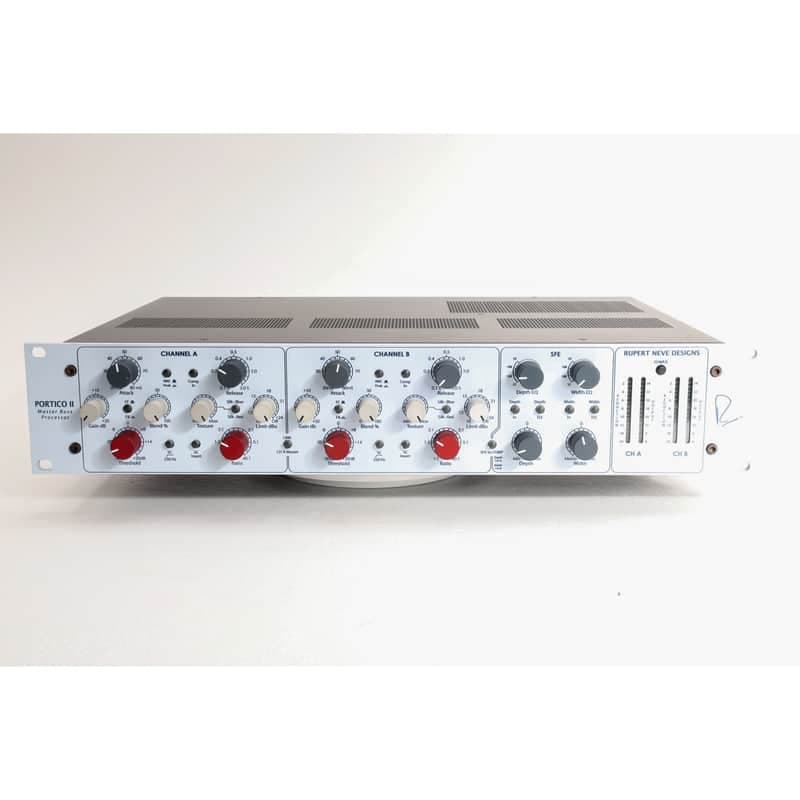
Rupert Neve Designs Portico II Master Buss Processor (Used) is a used item in excellent condition, listed on Reverb. The asking price is £2,696. It is offered by Sonic Circus through Reverb. It is in our Preamps & Channel Strips category. 23 similar listings have a median asking price of £2,885. Used Gear Hunter first saw this listing on 28 September 2026 and last saw it on 27 November 2026. It has been seen 66 times in our scans. Prices are converted from the seller's currency when we scan the listing, so the amount you pay may differ slightly. The seller sets shipping, and import duty or VAT may apply, so check the final cost and the item's details on Reverb before buying.
From the seller
Rupert Neve Designs Portico II Master Buss Processor (Used)
Based around the high voltage, discrete and class-A signal paths made famous in the 5088 Mixer and the Portico II Channel, the Rupert Neve Designs Portico II Master Buss Processor is a creative tool that redefines the boundaries and limitations of traditional 2-channel compression and limiting. Though originally developed for mastering applications, the MBP has quickly become a favorite of mix engineers, tracking engineers, and even FOH engineers. From mixing bass-heavy EDM to a delicate master of a chamber ensemble, it has something to offer everyone – no matter the use or genre.
With input and output transformers designed and implemented by Mr. Rupert Neve, the high-voltage 72V topology found in the Master Buss Processor will integrate flawlessly with virtually any system. Additionally, the Rupert Neve Designs Portico II Master Buss Processor incorporates mastering-grade detented pots throughout to fine-tune its revolutionary dynamics, tone, and stereo field controls. This new topology is a significant evolution of Mr Rupert Neve’s classic designs with appreciable benefits to headroom, dynamic range, distortion, noise, slew rate, bandwidth, and accuracy while still providing the sweet, musical performance that has been a part of countless recordings.
The Compressor
The MBP’s two compressor sections allow virtually limitless possibilities in dynamics for either dual mono or stereo sources, with controls for ratio, threshold, attack, release, blend, side chain HPF, limit and make up gain. When engaged, the compressor section can be used in both feed-forward and feed-back modes to provide a transparent modern response (feed-forward), or a smoother, more musical vintage response (feed-back). Peak mode alters the compressor’s attack to react to peak transients with a roughly .1ms response time. When the Peak switch is disengaged, the compressor responds to the RMS signal in conjunction with the attack and release settings. SC HPF inserts a high pass filter at 250 Hz into the side chain to deal with intense low frequencies that may skew the response of the VCA with certain songs and instruments. “Blend” creates a parallel mix between the compressed and dry signals. By mixing the compressed and dry signals, it is possible to increase the volume of quieter elements in the source material (for instance, delicate snare brushing on a track with much louder hits), while maintaining a natural dynamic feel for the louder elements.
To further control the side chain, there is also an insert “send” and “return” that may be paired with an external EQ or other filters for additional manipulation. The “return” may also be used as a “Key” input for ducking one signal to another (for instance, a voice-over keying the compressor to duck a background music track).
With the stereo link control engaged, Ch. A settings act as the master control for convenient operation.
The Limiter
The Rupert Neve Designs Portico II Master Buss Processor also features an extremely versatile, transparent and musical limiter. At first glance, one might scoff at the single knob operation – however, this limiter is extremely intelligent, knowing how to appropriately respond to the various signals presented to it. Our new Adaptive Release Technology is behind this revolutionary performance. Using a blend of release time constants, this limiter will simultaneously respond quickly to transient material (such as the “snap” of a snare drum) and slowly to more sluggish signals (such as a bass guitar). This configuration allows the limiter to grab a transient and let go just an instant later, while also dealing with more constant signals in a slower, more musical way. In this manner, the Rupert Neve Designs Portico II Master Buss Processor’s limiter can provide a much more aggressive amount of limiting than typically possible, while maintaining the essential character of the music and remaining free of the modulation distortion usually found in a fast-acting limiter.
Typically there is a tradeoff between how fast a limiter can react and the amount of modulation distortion in the lower frequencies. This is due to the lower frequencies finding their way into the side chain signal, triggering the compressor on and off very quickly, which ends up modulating the overall signal. This is interesting to look at with sine waves, but sounds quite undesirable with music. The Rupert Neve Designs Portico II Master Buss Processor does not have this tradeoff, and one is able to have the best of both worlds: a quick, snappy response while maintaining the integrity and smoothness of the low end. In addition to the adaptive time constant circuitry, the release time is also varied with the position of the knob. As the knob is turned counter-clock-wise, the release time is increased accordingly, as typically one would want a longer release time with a larger amount of reduction.
The new limiter found in the…