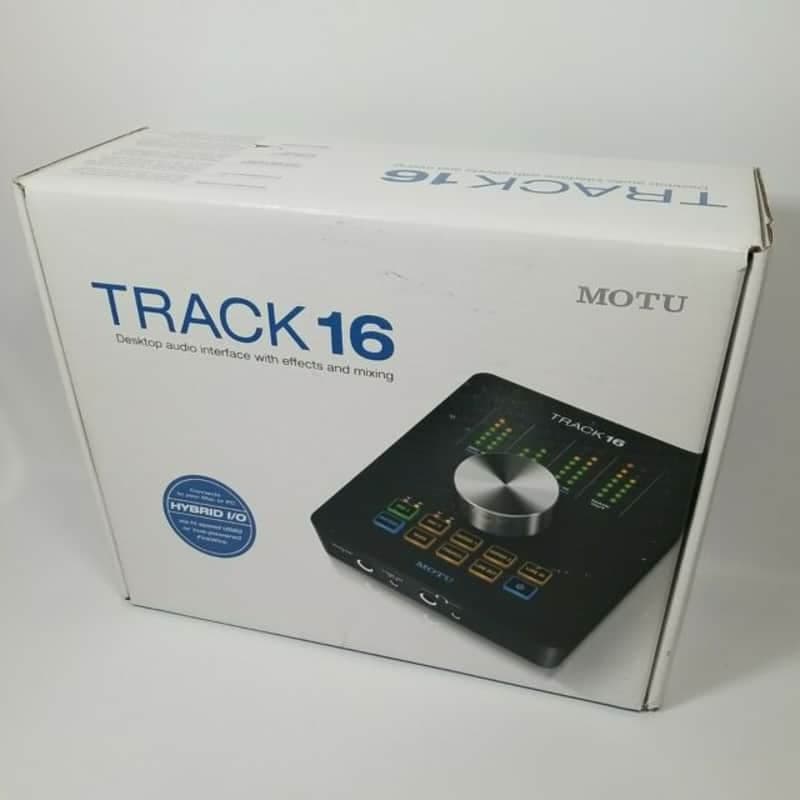
MOTU Track 16 - New Remote Control - NEW! is a used item in mint condition, listed on Reverb. The asking price is £349. It is offered by Music Motion through Reverb. It is in our Converters & Interfaces category. 8 similar listings have a median asking price of £184. Used Gear Hunter first saw this listing on 28 September 2026 and last saw it on 27 November 2026. It has been seen 65 times in our scans. Prices are converted from the seller's currency when we scan the listing, so the amount you pay may differ slightly. The seller sets shipping, and import duty or VAT may apply, so check the final cost and the item's details on Reverb before buying.
From the seller
Never opened, NEW. Pictures are from internet.
USB and Firewire Hybrid audio interface
24 bit 192 kHz
8 analog inputs and outputs
Microphone inputs (including phantom power)
Guitars and line signals
1x ADAT / S / PDIF input and output
Sym. and unsym. Input / Output
2 headphone outputs (3.5 mm and 6.3 mm)
Standalone function - operation as a 16-channel digital mixer without a computer
MIDI input and output
DSP mixer with EQ and compressor for each input / output channel
4 x 14 LED display
10 backlit buttons
Comprehensive software for real-time analysis and more
SMPTE timecode
Computer connection: 1x Firewire 400 (Type B - Buspowered) and 1x USB 2.0 (without Buspower)
including power supply
Windows and Mac drivers with 32 and 64 bit (requires Windows from Vist SP2 Mac from 10.5.8 - PPC G5 and Intel)
The picture is from the internet, the MOTU is stil in original pack, never opened, never used.
MOTU Track 16 - Review
USB & Firewire Interface For Mac & PC
MOTU have brought their expertise to bear on a new desktop audio interface, the Track 16.
Since Apogee introduced their Duet, the idea of a small yet highly specified desktop audio interface has caught on with other manufacturers. RME's Babyface showed that a compact and stylish box could also pack serious potential for expansion; thanks to the wonders of digital I/O, it can record up to 12 audio tracks simultaneously, yet it still fits comfortably into a largish coat pocket. The latest manufacturer to offer their take on this concept are Mark Of The Unicorn, whose Track 16 looks to be a direct competitor to the Babyface and to Apogee's Quartet.
The Track 16 itself is a smartly designed black box, about the size of a small but thick paperback book. The upper surface houses a large assignable rotary control, 10 buttons, and four pairs of LED ladder meters. One end proffers a single quarter-inch input for guitars, a stereo mini-jack line input socket, and a headphone output duplicated in both sizes. The other end houses optical sockets for ADAT In and Out, a standard square USB socket, and a Firewire socket; this is in the nine-pin format sometimes called Firewire 800, though the Track 16 is a Firewire 400 device. In the centre of these is a D-Sub connector through which the rest of the I/O reaches the Track 16.
The Track 16's additional I/O is accessed using a metre-long snake that's heavier than the Track 16 itself, and not always easy to arrange in the shape and position you want it. It terminates in a bundle of XLR, jack and other connectors, all of which are black; close inspection reveals moulded writing on the plastic barrels that tells you what each of them is, but as the writing is black too, it's far from obvious. I would have liked to see a more obvious labelling scheme — could the barrels have been different colours, for instance? As it is, I imagine that anyone buying a Track 16 will want to find a way to make it easier to distinguish the different cables at a glance, perhaps by adding tags to the cables.
The I/O available on the breakout cable includes a second high-impedance guitar input, a pair of balanced quarter-inch line inputs, a pair of mic preamps with digital gain control, four line outputs, and MIDI In and Out. There's also a power connector: the Track 16 can be bus-powered when connected via Firewire, but needs the included wall-wart power supply attached if you want it to work over USB, or if your computer's Firewire socket doesn't offer enough power. Annoyingly, the only Firewire cable that ships with the unit has nine-pin connectors at both ends, so if — like most PC owners — you only have a four-pin or six-pin socket on your computer, you'll need to buy another. As a consequence, I did most of my testing with USB. On the review model, incidentally, the cable's D-Sub connector slightly fouled the adjacent USB connector, pushing it sideways at a small angle. Nothing bad came of this during the review period, but I worry slightly about the long-term consequences.
During my tests I found I always needed to have the breakout cable attached — not only because I needed to attach the power supply, but because there are no line outputs on the unit itself. I imagine most people will likewise find they need the cable most of the time, but if you were, say, mixing on the move, and able to connect and power the Track 16 via Firewire, you could in principle run it as a headphones-only device sans breakout cable.
The 10 buttons have a rubbery feel, making them slightly reminiscent of the keys on a ZX Spectrum, except that they light up. The Power button has a blue LED, which lights continuously when all is well, but flashes if sync to an external clock is lost. So too does the Meters button, which switches three of the meters from monitoring input to output levels. One of the others is always lit in green, indicating that the assignable rotary control is performing that function, while the remainder light up red until…