Back to Browse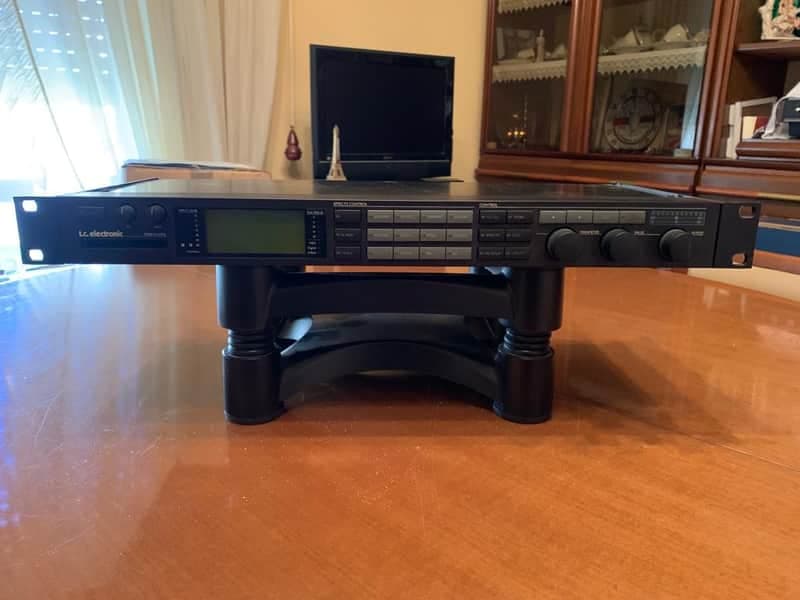
TC Electronic Fireworx - Nero
£524
Price dropped from £526
GoodReverb2mo agoLocal pickup available
Sold by
D
david's Gear Outlet
Details
- First Seen
- 28 September 2026
- Last Seen
- 27 November 2026
- Times Seen
- 65
About this listing
TC Electronic Fireworx - Nero is a used item in good condition, listed on Reverb. The asking price is £524. It is offered by david's Gear Outlet through Reverb. Local pickup is available. It is in our Outboard Effects category. Used Gear Hunter first saw this listing on 28 September 2026 and last saw it on 27 November 2026. It has been seen 65 times in our scans. Prices are converted from the seller's currency when we scan the listing, so the amount you pay may differ slightly. The seller sets shipping, and import duty or VAT may apply, so check the final cost and the item's details on Reverb before buying.
From the seller
n a world brimming over with multi‑effects units, will TC Electronic's new FireworX cause sparks to fly amongst the competition? Hugh Robjohns lights the blue touch‑paper...
There are probably more effects units on the market today than almost any other type of musical equipment (with the exception of guitar amplifiers perhaps), and with so much competition the leading manufacturers are always looking for that certain something which gives their product the edge over everyone else's. An increasingly popular approach in recent years has been to provide the means to chain multiple effects together, and as affordable digital signal processing has grown ever more powerful, so multi‑effects units have become far more capable. However, sheer processing power is not enough on its own — you need a well thought out user interface to be able to control and make creative use of it.
The FireworX is the latest in an impressive line of signal processors from Danish company, TC Electronic. It offers around 40 different high quality, innovative, and extremely configurable effects algorithms, and the typically intuitive TC user interface. Not only does the FireworX allow enormous flexibility in how the different effects programs can be combined, but it also provides an extraordinary degree of real‑time control opportunities as well, across literally dozens of different effect algorithm parameters. Building that level of functionality into a 1U rackmount box is impressive enough, but to do so whilst retaining a manageable user interface makes the FireworX worthy of further investigation.
Hardware
The FireworX is housed in a standard 1U rackmount box, finished in the traditionally innocuous studio black. The rear panel is quite busy, starting with an IEC mains inlet and power switch on the left, followed by two pairs of XLRs providing balanced stereo analogue inputs and outputs (both software configurable for nominal +4dBu or ‑10dBV signal levels). Digital interfacing is extremely comprehensive too with AES‑EBU and S/PDIF stereo I/Os plus ADAT and/or Toslink optical input and outputs. It makes sense to offer the ADAT interface since it uses the standard Toslink connectors anyway, and TC have provided set‑up menus allowing any two channels to be used within the eight‑channel ADAT format.
Although not fitted on the review model, an optional word clock input (standard TTL signal on a BNC connector) can be installed to allow external synchronisation in the digital domain. The rear panel of the device is rounded off with the usual trio of MIDI connectors and a quarter‑inch jack socket is provided for external hardware controllers, such as a pedal or footswitch (software menus configure the required functionality).
Internally, the FireworX is beautifully engineered, as we have come to expect from these Danish masters. An elegant switched‑mode power supply is carefully screened off to one side of the case, while a large and heavily populated motherboard fills most of the remaining floor area. Surface‑mount components proliferate and a socket on the motherboard accepts PCMCIA memory cards inserted through a slot in the front panel. The analogue I/Os feature delta‑sigma 1‑bit, 128 times oversampling AKM converters, which provide a claimed 24‑bit resolution and an overall dynamic range of around 100dB.
Controls
The front panel of the machine is clean and tidy to look at, with clearly marked controls and buttons (most with internal LEDs). To the extreme left is a power standby button (the mains isolating switch is on the rear panel), accompanied by input and output level trim controls for the analogue I/Os (from ‑22 to +10dBu). A backlit LCD panel is edged with LED bargraphs — the two on the left showing left and right input level from ‑24 to 0dBFS. The column of LEDs to the right of the display window indicates the amount of gain reduction (up to ‑20dB) being applied when a dynamics effect 'module' is in use. Three status indicators show MIDI activity, digital lock (to an external reference signal), and when a preset program patch has been edited.
The main control functions start with a column of three large black pushbuttons which provide a complete signal bypass through the machine, set the tempo (by tapping) for a given effect's modulation, and allow algorithm control parameters to be allocated to the 'alpha‑mod' control knob at the extreme right‑hand end of the unit (more on this in a moment). A central bank of 12 grey buttons are used to indicate which effects algorithms are in use in the current configuration, as well as allowing them to be individually bypassed and edited. A block of six more black buttons provides access to the preset memory functions, insert effects algorithms in the processing chain, control the 11 internal and nine external effects modifiers (for parameter modulation), configure the audio I/Os, and access the various utility functions.
The last right‑hand quarter of the front panel contains just…