Back to Browse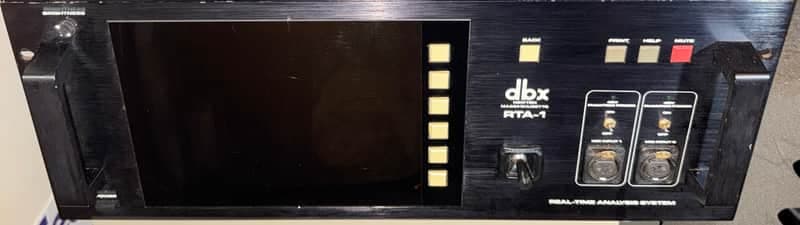
dbx RTA-1 REAL-TIME ANALYSIS SYSTEM POWERS-UP, SOLD AS-IS 1980
£1,145
Price dropped from £1,149
FairReverb2d ago
Sold by
W
WM PRODUCTIONS STUDIOS
Details
- First Seen
- 25 November 2026
- Last Seen
- 27 November 2026
- Times Seen
- 6
About this listing
dbx RTA-1 REAL-TIME ANALYSIS SYSTEM POWERS-UP, SOLD AS-IS 1980 is a used item in fair condition, listed on Reverb. The asking price is £1,145. It is offered by WM PRODUCTIONS STUDIOS through Reverb. It is in our Microphones category. Used Gear Hunter first saw this listing on 25 November 2026 and last saw it on 27 November 2026. It has been seen 6 times in our scans. Prices are converted from the seller's currency when we scan the listing, so the amount you pay may differ slightly. The seller sets shipping, and import duty or VAT may apply, so check the final cost and the item's details on Reverb before buying.
From the seller
1-dbx RTA-1 REAL-TIME ANALYSIS SYSTEM POWERS-UP, SOLD AS-IS
I have two of these RTA-1's that I will be listing. This listing is for the one that powers-up and when I plugged in my RTA microphone, the video monitor displayed its audio. All switches responded when selected. The monitor has some caps that need to be replaced that will probably fix the lines in the display. Please look at all the pictures I’ve posted for condition.
Because of its age, this is being offered in as-is condition. No returns. If you’re interested in the second one that didn't power-up. Let me know.
Looking for info on the DBX RTA-1, all I really could find is this post and when talking to Don Dueed (Don B) the original design engineer of the RTA-1 I asked him if I could use this post. Here is the post.
Me,
I have two of these dbx RTRA-1's I purchased years ago. One from Disney World around 2008 and the other one I think from LMG in Orlando. The bad thing is I never used them to ther full potential not getting a manual with ether one. Do you mind if I use this info in my listing? It was great reading this post. I haven't powered each one up yet but I should probably slowly power it up using a variable transformer. When I last used the one from Disney back in 2008, The display had some horizonel lines in it that went from the bottom left to the top right. If I rtemember right, they got more noticeable when you turned the brightness up. Probably need new caps. Anyway thankS for your post.
Don Dueed (Don B)
I'm the original design engineer of the RTA-1. I ran across your post here as I was preparing to move from the house I've lived in since 1985, when I was still working at dbx.
I noticed one of your posts mentioned someone who is still maintaining RTA-1s. I think I know who that is but I don't know how to get in touch. Can you pass along the contact information for that person? If you doubt my bona fides, you can pass along my name (below) and I'm sure he'll remember me.
If that doesn't work out for some reason, I can at least offer you the key caps you're missing!
By the way, you're right about the pink noise filter. I wrote a little in-house white paper on that -- we wanted to get the worst-case error in the pink noise curve down below +/- 1 LSB of the D/A converter.
- Don B.
I am trying to think of any dbx engineer from my era whose name started with K but I'm coming up empty. Memory is shaky after 34+ years. Sadly I didn't stay in touch with my old colleagues from the dbx days.
Oh, cool. I've lost touch with Les and Gary. (His last name is Hebert, by the way.) I left the audio field and drifted away from my dbx colleagues. It's a shame -- I was pretty close friends with Les back in the day. Spent many an evening at his house in Groton, MA. I know he's moved since then, though. Did you know Les is a talented pianist, and Gary is a kickass drummer?
For those unfamiliar with the RTA-1, I thought I'd write up a description of its unique capabilities.
Like other pro spectrum analyzers, the RTA-1 can accept a signal input from a variety of sources and produce a display of the signal's spectrum in real time. The RTA-1 uses 1/3-octave filters, so it breaks down the audio into around 30 bands. So far, nothing too unusual.
The RTA-1 was targeted toward acoustics professionals such as touring sound companies and room acoustics consultants. For example, in concert venues, the RTA-1 could be used to provide the information needed to equalize the room -- and it could do so without the need to drive the room with pink noise. Instead, it could provide an accurate room-response spectrum using music as the signal source!
How did it do that? It had the hardware, and the smarts, to keep track of two signals simultaneously. So you could feed your music to one input of the RTA-1 (and to the PA system), and "listen" to the room with a mic connected to another RTA-1 input. As your intro music played, the analyzer would compare the two signals, note the difference in the responses, and display that difference -- i.e. it would show the room response curve.
This means the sound engineer could not only get a room curve without blasting everybody with pink noise, but could also run the process repeatedly even as the audience filled the venue, so the effect of the audience itself could be corrected for.
A second major feature of the RTA-1 was aimed at acoustics consultants. An important factor in room acoustics is reverberation time -- i.e. how quickly a given sound will damp out. This can and does vary across the spectrum due to various factors (room dimensions, reflective surfaces, absorbent materials, etc.)
The RTA-1's RT-60 function makes taking reverb time measurements simple. It has a precision pink noise generator that can be connected to a PA system or other sound source. When triggered, the RTA-1 turns on the pink noise to drive the room with broadband noise, then shuts off the signal and takes a series of "snapshots" of the…