Back to Browse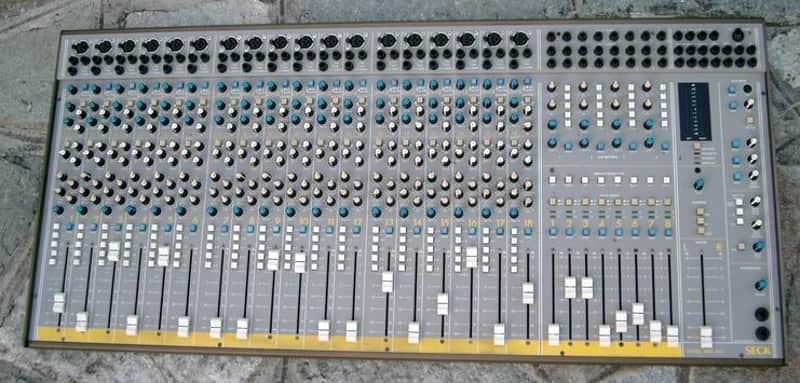
Seck 1882 MKII Studio and Live Console with power supply
£612
Price dropped from £614
Very GoodReverb2mo agoLocal pickup available
Sold by
A
Albert's Collection HENDRIXGUITARS Italy
Details
- First Seen
- 28 September 2026
- Last Seen
- 27 November 2026
- Times Seen
- 66
About this listing
Seck 1882 MKII Studio and Live Console with power supply is a used item in very good condition, listed on Reverb. The asking price is £612. It is offered by Albert's Collection HENDRIXGUITARS Italy through Reverb. Local pickup is available. It is in our Consoles & Mixers category. Used Gear Hunter first saw this listing on 28 September 2026 and last saw it on 27 November 2026. It has been seen 66 times in our scans. Prices are converted from the seller's currency when we scan the listing, so the amount you pay may differ slightly. The seller sets shipping, and import duty or VAT may apply, so check the final cost and the item's details on Reverb before buying.
From the seller
Seck 1882 MKII Studio/live Console with power supply
Following on from the Seck 122, the new 1882 mixer offers a vast range of facilities housed within a compact case that even the Japanese would be proud of. Paul Gilby takes a look at this British thoroughbred and discovers a mixer that's happy both in the studio and on the road.
From time to time you receive a piece of equipment for review that makes you ooze with excitement. After jostling with the box you take a quick look at the features and that's it; an immediate impression is formed before a more thorough testing is performed at the time of writing the review.
In the case of the Seck 1882, you're presented with a very thin mixer that's visually striking and smartly laid out across its one metre width (39 inches for British readers). It is often said by the designers of this world that when a product looks good, its form and structure are usually an integral part of the design. So, in general terms what looks good performs well - just take a look at the Lotus Esprit.
The Seck 1882 is a perfect embodiment of those ideals, for which the design team involved must be congratulated. When you use this mixer your hand seems to go in search of a particular control and there it is at your finger tips. What's more you keep finding features that are so useful you wonder quite how they fit them all into such a small space, yet manage to retain an open feeling that isn't cramped. Ergonomics is the keyword and this is a splendid example of its application.
Conclusion
As I'm so taken with this mixer, I thought that I would present you with the conclusion now so that you don't have to wait to the end of the review; something to catch out all of you who jump straight to the end of equipment reviews and spoil the story.
The Seck 1882 mixer is, without doubt, one of the most versatile and compact units on the market today. Its facilities offer almost everything you would desire including a slightly unorthodox EQ stage that surprisingly, sounds better in reality than it looks on paper. The icing on the cake, however, has got to be the mixer's routing system which has certainly taken a leaf out of the big boys' book; Soundcraft, Harrison and the like.
As a recording mixer, it's not far short of perfect and even in a PA situation any sound engineer will certainly find it a pleasure to use. Usually, when a product like a mixer starts life on the designer's drawing board, everybody involved sits around saying things like, 'it must have this' and 'it must have that', until it becomes prohibitively expensive and grows to a monster of a size. Well, they did give it that and the other, built it in a small case and called it the 1882; quite remarkable.
Down To Earth
The Seck 1882 is an 18 input channel mixer with 8 subgroups that may be switched between two sets of outputs which would normally be wired directly to a 16 track tape recorder such as the Fostex B-16, or equally so to an 8 track like the Tascam 38. A stereo master output is also provided which may be configured to act as two additional subgroup outputs, or when in a PA situation they can be used as the master output feeds to the PA stack.
The mixer follows some of the 'in-line' design philosophy where each input channel has its own monitoring controls (18 in all) rather than the usual approach of taking the monitoring off the subgroup outputs. This arrangement can initially be overwhelming for some people but Seck have laid the mixer's controls out so well that its operation is straightforward.
Channel 4
Each input channel is identical so, diagram at the ready, the rundown goes something like this. As the mixer is thin and flat all connections are mounted along the top of the mixer, each channel having its relevant sockets clearly distinguished from the next. We start with the microphone input which is via a latching XLR three pin socket riveted into place and wired pin 3 hot. The line input is a standard jack socket wired for balanced operation though it may be used unbalanced. Tape return is via a -10dBV input and there's one on each of the 18 channels which is unusual when you consider this to be a budget-priced mixer.
Last of all, is the insert point socket which is wired to accept a stereo jack plug and uses the tip connection to send a signal out and the ring for receiving the returned processed signal. This insert point is accessed prior to the EQ stage and, therefore, any noise picked up from external processing units may be tackled with the EQ on its return to the channel. With no plug inserted, the signal runs straight through the channel. Next in line, is the input gain control and its friend, the mic/line selection switch. Pretty self-explanatory. Immediately under the input section comes the monitoring but we'll skip over this for the moment and head for the auxiliaries.
Although the mixer has a total of six Aux sends (each identified by a white coloured knob), the main recording signal path…