Back to Browse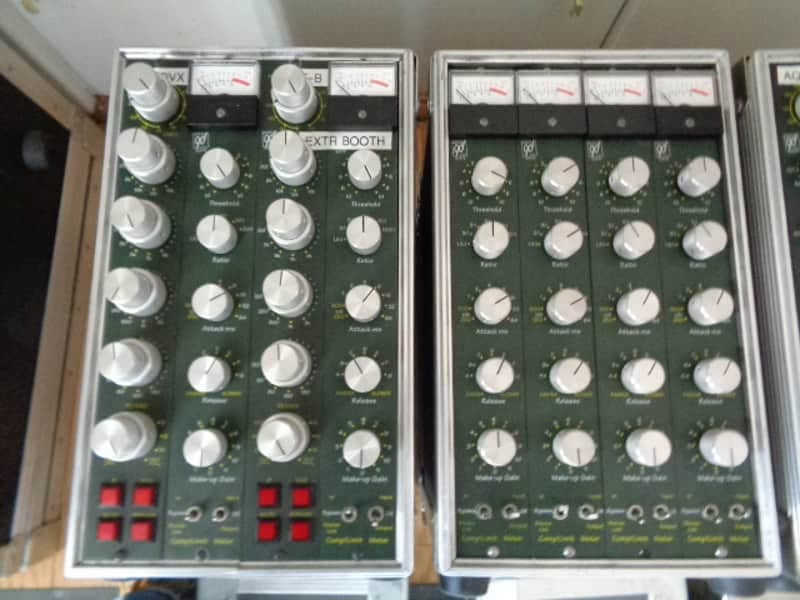
Daking 52270 Mic Preamps / 91579 Compressor Limiters ... circa 1990
£22,971
ExcellentReverb1mo agoLocal pickup available
Sold by
N
Nobtwiddlers wharehouse of gear
Details
- First Seen
- 28 September 2026
- Last Seen
- 26 November 2026
- Times Seen
- 64
About this listing
Daking 52270 Mic Preamps / 91579 Compressor Limiters ... circa 1990 is a used item in excellent condition, listed on Reverb. The asking price is £22,971. It is offered by Nobtwiddlers wharehouse of gear through Reverb. Local pickup is available. It is in our Preamps & Channel Strips category. Used Gear Hunter first saw this listing on 28 September 2026 and last saw it on 26 November 2026. It has been seen 64 times in our scans. Prices are converted from the seller's currency when we scan the listing, so the amount you pay may differ slightly. The seller sets shipping, and import duty or VAT may apply, so check the final cost and the item's details on Reverb before buying.
From the seller
I own 8 of these racks, willing to let 4 go due to unexpected last minute move and lack of space.
Been racked since purchased (New from Geoff himself)
Every switch, lamp, etc works.
These sound absolutely fabulous.
All cables and power supplies included.
Selling all 4 x Racks for $30,000.
That includes:
10 x 52270 Mic pre-Eq's
6 x 91579 Limiters,
All cases, power cables, and supplies.
These are Now Located in Sharon CT,
Pickup here is fine.
I personally WILL NOT PACK OR SHIP.
But there are a few pack & ship joints around, and you can call them for a quote.
I'd be happy to drop them off to them if need be.
~~~~~~~~~~~~~~~~~~~~~~~~~~~~~~~~~~~~~~~~~~~~~~~~~~~~~~~~~~~~
If you read Daking's promotional literature, this is his take on Trident A Range modules.
All discrete Class A circuitry
These are well-built units are somewhat larger than API modules. Power comes from a separate box via 25-pin D-connector leads. The power supply can accommodate up to four modules.
All controls except the EQ Gain/Cut and Mic Pre Fader knobs are switchable. Much is made of the fact that the big metal knobs are custom made. I like their size, but they have a rough, clunky feel.
The Mic Pre's coarse switchable gain is slightly confusingly labelled with nominal input level rather than gain, so it looks backwards at first. Positions to the right are for Line input. In the centre of this is a fader pot, which negates any need to use a desk channel. Switches for Phase, Pad, Mute and Bypass all illuminate and utilise relays with gold contacts. The Mic Pre is wonderfully upfront and exciting, making instruments and vocals sound beautifully enhanced, even with lowly dynamic microphones. Everything sounds punchy and crystal clear, with astonishing presence, but paradoxically more natural than the perceived ultra-high frequency detail of Focusrite designs. This suits most acoustic instruments and vocals well, although very occasionally (such as with a mic'd bass cab) something less bold seemed more appropriate.
I love the Mic Pre ! The EQ is four band, (two shelving and two peaking) with no bandwidth controls and just four switched frequencies per band (and an Off position). Daking makes the point that sweepable pots are cheap components, whereas switched knobs cost considerably more. These frequencies are based on a rare 1970's Trident design, and are extremely well chosen, with 17dB boost on the mid peaks, 15dB boost on the shelves, and 15dB cut across the board. This is very powerful, and really enjoyable to use when making gentle or bold changes to voices and instruments, as if one is sculpting the sound. Perhaps deliberately, there is no legending or calibration of the EQ Gain/Cut pots. There are also switched High- and Low-Pass 12dB per octave filters, each having only three settings.
Now the 91579
The Compressor/Limiter features Line Input and Stereo Link sockets of the dual Jack/XLR type, while output is on XLR. The VU meter seems to work well, although illumination may have been useful. It can be toggle-switched to show Input, Output and Gain Reduction. A second toggle-switch enables stereo-link and bypass modes. All rotary controls are switched, which with 2dB steps means any really fine threshold adjustment must be made externally with the level before signal arrives. Ratios can be chosen at 1.5:1, 2:1, 3:1, 5:1, 10:1 and 20:1. Of course, much depends on the Attack and Release settings. Attack is calibrated from 250µs to 64ms with nine settings. Release is labelled A to G (seven settings) and is quite novel. 'A', 'B' and 'C' represent fixed settings of 0.5, 1.0 and 1.5s respectively. Position 'D' replicates the dual time constant auto setting of the Neve 33609. 'E' is the dual time constant of the Audio Design Compex auto setting. 'F' and 'G' are copies of the triple time constant settings of the Fairchild 670 auto positions 5 and 6 respectively. These are superb recreations, and sound warm and smooth. The faster settings are great on drums and sometimes vocals.