Back to Browse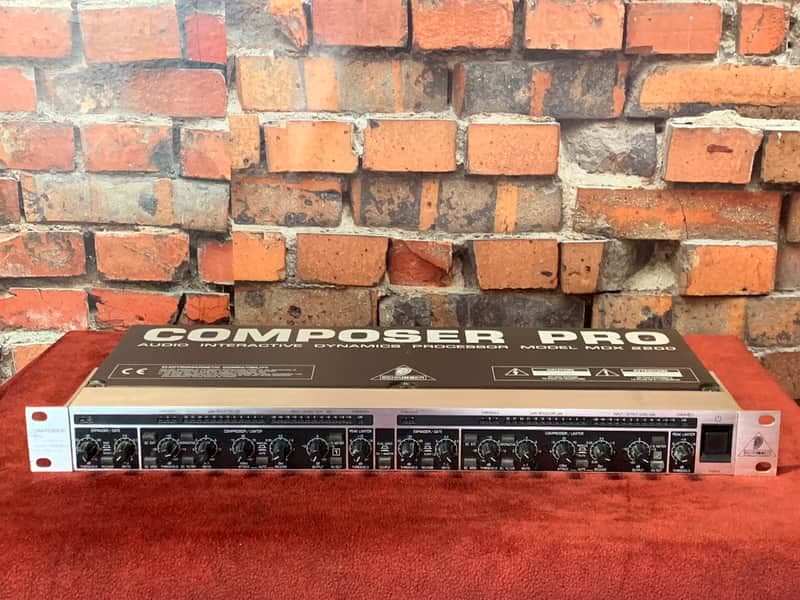
Behringer Composer Pro MDX2200
£79
Very GoodReverb1mo ago
Sold by
D
Dr.Music
Details
- First Seen
- 28 September 2026
- Last Seen
- 26 November 2026
- Times Seen
- 64
About this listing
Behringer Composer Pro MDX2200 is a used item in very good condition, listed on Reverb. The asking price is £79. It is offered by Dr.Music through Reverb. It is in our Compressors & Dynamics category. Used Gear Hunter first saw this listing on 28 September 2026 and last saw it on 26 November 2026. It has been seen 64 times in our scans. Prices are converted from the seller's currency when we scan the listing, so the amount you pay may differ slightly. The seller sets shipping, and import duty or VAT may apply, so check the final cost and the item's details on Reverb before buying.
From the seller
The latest version of Behringer's Composer dynamics processor appears to provide all the facilities anyone could ask for, with a separate expander/gate, compressor and limiter for each of its two channels.
Dynamic control is one of the most important but often overlooked aspects of recording. Good as modern recording technology is, it still can not quite achieve the 140dB dynamic range of human hearing. The best mic preamplifiers might be capable of about 125dB dynamic range, and the best power amplifiers and loudspeakers maybe 110dB. Even then, no one at home or in their car is going to want (or be able to cope with) real‑life dynamics, so it is inevitable that the dynamic range of recorded music has to be reduced and controlled.
Dynamic control can be performed in many ways. You can modify your performance to restrict the range between your loudest and quietest passages, or 'ride' the faders in anticipation of loud or quiet sections either at the time of the recording or during the subsequent mixdown or mastering. Alternatively, some form of automatic controller can be used to raise quiet sections or reduce louder ones — enter the compressor and limiter.
Sometimes, it is also desirable to actually increase the dynamic range of a recorded signal. This might typically be when there is a relatively high level of unwanted background noise which is effectively masked during the music but becomes obtrusive in the breaks. By increasing the dynamic range downwards, low‑level noises can be pushed down to inaudibility — enter the expander and gate. The Behringer Composer Pro offers all these tools in a neat, easy‑to‑use, but powerful package.
The Composer Pro MDX2200 is a modest 1U rackmounting unit measuring a minuscule 190mm front to back. The front panel is polished aluminium with white‑on‑black screen printing and the controls are laid out in a very clear and logical manner. With the exception of the large power button, all function switches are illuminated, and each channel sports its own input/output level bargraph meter as well as a gain‑reduction meter and traffic‑light threshold indicators for each of the separate dynamics sections.
The rear panel is comprehensively equipped with both TRS quarter‑inch jack sockets and XLRs for the inputs and outputs (all electronically balanced), as well as a pair of tip‑sleeve unbalanced jack sockets for side‑chain send/receive connections. Rear‑panel push buttons independently select +4dBu or ‑10dBV operating levels for each channel, and power is provided through a standard IEC mains inlet.
The two channels are equipped with identical sets of controls consisting of eight knobs (all with 41 light detents), eight illuminated push buttons, three threshold indicators and two bargraph meters. The first two rotary controls adjust the threshold and ratio of the expander/gate stage. The threshold ranges between +15dB and Off (below about ‑70dB) relative to the selected operating level, and the ratio can be set anywhere between 1:1 and 1:8. There are no attack or release controls, although the release time can be switched from fast to slow (via an illuminated button between the two knobs), and there is also no depth (or range) facility.
The compressor/limiter stage is far more generously appointed, with threshold, ratio, attack, release and output controls. Threshold extends between ‑40 and +20dB (relative to the selected operating level), ratio from 1:1 to infinity:1, attack between 1 and 150 milliseconds, release from 0.05 to 5 seconds, and output level between ‑20 and +20dB. The separate peak limiter section consists of a single control scaled between 0dB and Off (in excess of +20dB relative to the selected operating level).
Between the Threshold and Ratio controls, an illuminated push button engages the IKA soft‑knee mode if required (see the 'Special Features' box on page 62). Three other buttons (two to the left and the third below the IKA switch) are associated with the compressor side‑chain. A high‑pass filter can be introduced into the side‑chain to help reduce the compressor's sensitivity to loud low frequency signals such as kick drums and bass guitars. No specifications are given for this filter, but I would estimate it to reduce signals quite dramatically below about 100Hz. The other (illuminated) buttons activate the external side‑chain return path, and allow the returned signal to be auditioned on the main programme output. This facility is very useful when tuning an external side‑chain equaliser, perhaps for de‑essing duties, but is obviously dangerous from an operational point of view, so the illuminated button flashes when it is engaged.
Between the attack and release controls, another illuminated button provides an automatic, programme‑dependent attack/release mode. Finally, to the right of the Output level control, a button bypasses the entire compression signal path, providing a direct relay connection between the input and output connectors. A…